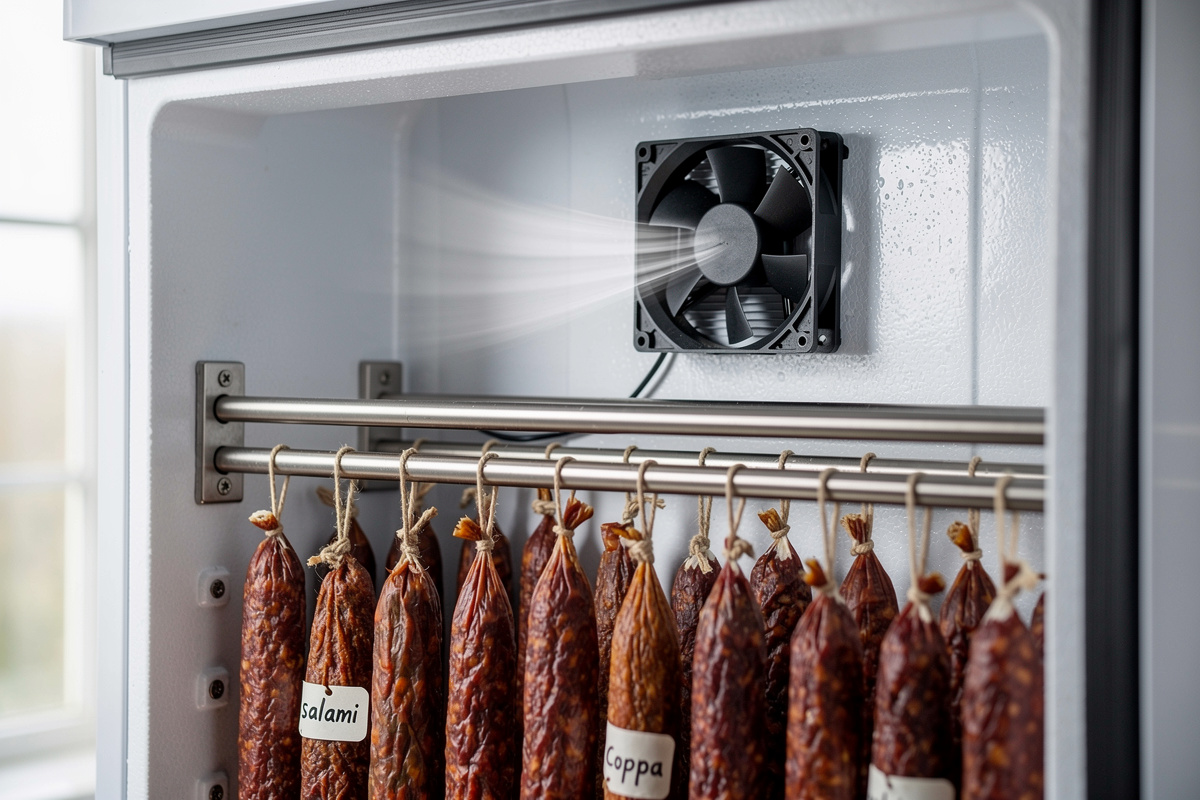

The right curing chamber airflow fan is a 120mm PC fan run at low speed on a 5-minutes-on, 25-minutes-off cycle, mounted to blow across the meat, never at it. You do not need much CFM — gentle, even movement breaks the saturated layer around the meat without case-hardening the surface.
Airflow is the most-skipped layer of climate control and the one that quietly decides whether your humidity readings mean anything. Across the chambers I run, a cheap 120mm computer fan on a timer is the difference between salami that dries evenly and salami that grows surface mold while the sensor swears the chamber is at 75% RH. Here is how to size, place, and cycle that fan, and why more airflow is not better.
Why Airflow Matters More Than CFM
Airflow in a curing chamber exists to break the saturated boundary layer that forms around hanging meat — a thin film of near-100% RH air clinging to the surface even when the chamber reads 75%. Break that film with gentle movement and the surface dries at the chamber rate; leave it and you grow unwanted surface mold while your hygrometer reads fine.
This is why CFM is the wrong thing to chase. The goal is not to move a lot of air, it is to move a little air everywhere, evenly, on a cycle. Too little and a saturated dead zone forms around the meat and humidity pools in chamber corners; too much constant airflow and the surface dries faster than interior moisture can migrate out, sealing the hard shell of case hardening. The whole game is a gentle, intermittent breeze — the same principle the climate control hub calls Layer 3, and the variable that determines case hardening more than temperature or humidity alone.
Fan Size: Why a 120mm PC Fan Wins
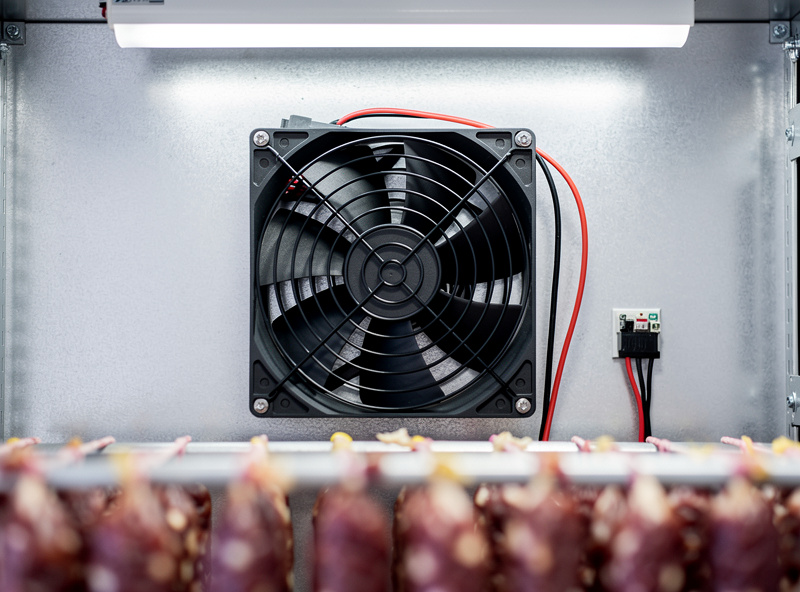
A 120mm PC case fan is the standard choice: it moves enough air at low RPM to circulate a fridge-sized chamber, runs on quiet 5–12V DC, costs a few dollars, and is trivially speed-controlled. Bigger axial or inline duct fans move far too much air for a home box and dry surfaces too fast.
The reason the 120mm size dominates is that it hits the sweet spot of low-speed, low-noise, low-power movement. A 120mm fan at full 12V might be rated around 50–75 CFM, but you rarely run it there — drop the voltage or PWM it down and it whispers a gentle current through the chamber. A 140mm fan works equally well and is slightly quieter at the same airflow. What you avoid is anything designed to actually ventilate a room: bathroom inline fans and high-static duct fans will case-harden a salami in 48 hours. A quiet 120mm PC case fan is the right buy, ideally a low-RPM model.
Disclosure: CuringChamber is reader-supported. As an Amazon Associate I earn from qualifying purchases made through links in this article, at no extra cost to you. I only point to gear I actually use or would buy for my own chamber.
Fan Placement: Across the Meat, Never At It
Mount the fan on the back wall or the top of the chamber, aimed to push air across the hanging meat and along the walls, not blasting directly onto a piece. A fan pointed straight at a salami dries that one face into a hard patch while the rest of the chamber stays stagnant.
The aim is a slow circular current that sweeps the whole interior — air moving past every piece, into the corners, and back. Back-wall mounting blowing toward the door, or top mounting blowing down one side, both set up that loop. Keep the fan well away from the humidifier outlet so it distributes the fog rather than firing it onto nearby meat. And keep your sensor probe out of the direct stream, at meat-shelf height, or it reads moving air differently than the still pockets where the meat actually hangs — the placement logic that ties into the smart sensors setup. Good placement is what lets a tiny fan do the work of a much bigger one.
Testing Airflow: The Tissue Paper Trick
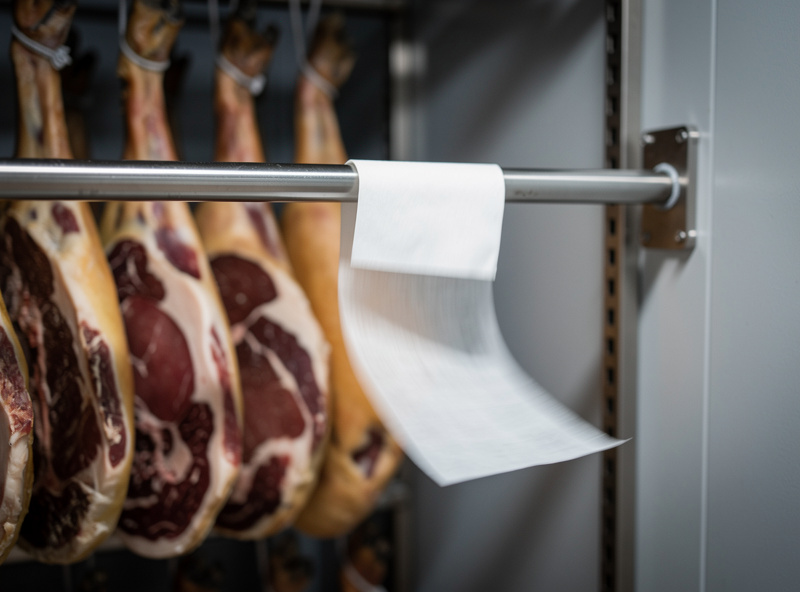
Test chamber airflow by hanging a strip of tissue paper or a thin ribbon from a rod at meat height: it should sway gently when the fan runs, not flap or hang dead still. A gentle, visible sway is the target across every shelf, top to bottom.
Do the test at several heights and positions, because tall chambers stratify and the bottom shelf often sits in dead air while the top moves fine. If the tissue flaps hard, dial the fan down with a speed controller or move it off direct line. If it hangs limp in a corner, the loop is not reaching there — reposition the fan or add a small deflector. This five-cent diagnostic tells you more about real airflow than any CFM rating on the fan box, and it is how I balance a chamber after any change. A simple 12V fan speed controller makes dialing the sway in trivial.
Duty Cycle: Cycling Beats Constant
Run the fan on an intermittent cycle, not continuously. A 5-minutes-on, 25-minutes-off schedule is the home-charcuterie default: it refreshes the air and breaks boundary layers every half hour while leaving long still periods so the surface does not dry too fast. Dry-aged beef is the exception, wanting more constant gentle flow.
Constant airflow is the single most common cause of case hardening I see in new builds — the fan never stops, the surface never gets a humid rest, and the piece crusts. Cycling fixes it. Use a cheap programmable outlet timer, a smart plug, or a fan controller with an interval mode; the full automation approach, including running the fan and compressor on coordinated schedules, is in smart plug schedules for curing chambers. Tune the ratio to your chamber: a leaky or humid box can take more on-time, a tight dry one less. Salami and whole-muscle live happily on 5/25; only colder dry-aging work shifts toward more constant flow.
| Fan / method | Typical airflow | Control | Noise | Best for |
|---|---|---|---|---|
| 120mm PC fan | ~50–75 CFM at 12V (run lower) | Voltage / PWM, timer | Very quiet | Most home chambers |
| 140mm PC fan | Similar, quieter per CFM | Voltage / PWM, timer | Quietest | Larger fridge chambers |
| USB clip fan | Low, fixed | On/off only | Quiet | Tiny bar-fridge chambers |
| Inline duct fan | Far too high | Variable | Loud | Air exchange only, not circulation |
| No fan (passive) | None | None | Silent | Not recommended — boundary layer forms |
Circulation vs Fresh-Air Exchange
Internal circulation and fresh-air exchange are two different jobs. The 120mm fan circulates air inside the chamber to break boundary layers; fresh-air exchange brings a little outside air in to keep the box from going stale. For home charcuterie the circulation fan plus the air swap from opening the door for checks usually covers both.
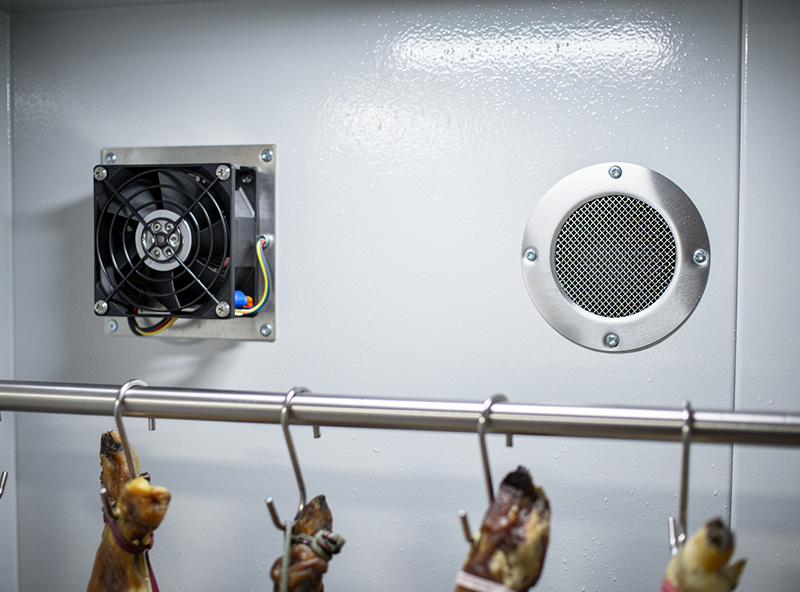
Whole-muscle and salami do not produce much gas, so a sealed chamber with a small passive vent — a drilled hole with a screened cap — and routine door-opening exchanges enough air. If you smell anything stuffy or ammonia-like, increase exchange slightly with a brief fan-driven vent or a second small intake hole, but resist the urge to over-ventilate, which just fights your humidity. Cold-smoking is the one case that needs deliberate through-flow, since smoke has to move; that is a different airflow problem from drying. For the standard drying chamber, gentle internal circulation is 95% of the airflow story, and it sits alongside the humidifier and dehumidifier as the third leg of holding a stable envelope.
Frequently Asked Questions
What size fan do I need for a curing chamber?
A 120mm PC case fan is the standard choice for a fridge-sized curing chamber. It moves enough air at low RPM to circulate the box, runs quietly on 5 to 12V DC, costs a few dollars, and is easy to speed-control. A 140mm fan works equally well and is slightly quieter. Avoid high-CFM duct or bathroom fans.
How much CFM does a curing chamber fan need?
Very little. CFM is the wrong metric to chase because the goal is gentle, even movement, not high volume. A 120mm fan rated 50 to 75 CFM at full 12V is run well below that, dialed down with voltage or PWM. Too much airflow case-hardens the meat surface faster than interior moisture can migrate out.
Where should I mount the fan in a curing chamber?
Mount it on the back wall or top, aimed to push air across the hanging meat and along the walls, never blasting directly onto a piece. Direct airflow dries one face into a hard patch while the rest stays stagnant. The aim is a slow circular current that sweeps the whole interior and reaches the corners.
Should the curing chamber fan run constantly?
No. Run it on an intermittent cycle, typically 5 minutes on and 25 minutes off. Cycling refreshes air and breaks boundary layers every half hour while leaving still periods so the surface does not dry too fast. Constant airflow is the most common cause of case hardening in new builds. Dry-aged beef is the exception, wanting more constant gentle flow.
How do I test airflow in a curing chamber?
Hang a strip of tissue paper or thin ribbon from a rod at meat height. It should sway gently when the fan runs, not flap hard or hang dead still. Test at several heights since tall chambers stratify and the bottom shelf often sits in dead air. Gentle visible sway everywhere is the target.
Does a curing chamber need fresh-air exchange?
A little. Internal circulation and fresh-air exchange are different jobs. The 120mm fan circulates air inside to break boundary layers; fresh-air exchange brings in a little outside air. For home charcuterie, the circulation fan plus the air swap from opening the door for checks, aided by a small screened vent hole, usually covers both without over-ventilating.
Why is my chamber humid but the meat still moldy on the surface?
That is the boundary-layer effect from too little airflow. A saturated film of near-100 percent RH air clings to the meat surface even when the chamber reads 75 percent, growing surface mold while the sensor reads fine. A gentle cycling fan that sweeps across the meat breaks that film and fixes it without case-hardening the surface.
Related Articles
- Curing Chamber Climate Control: The Complete Guide — airflow as Layer 3 of the system.
- Case Hardening in Curing Chambers — the failure too much airflow causes.
- Smart Plug Schedules for Curing Chambers — cycling the fan automatically.
- Curing Chamber Humidifier: Ultrasonic vs Wick vs Steam — the fan distributes the fog.
- Curing Chamber Dehumidifier: When and How to Size It — airflow lets the dehumidifier reach the meat.