Why Are My Sausages Rubbery? Fixing Overworked and Over-Bound Texture
July 19, 2026

A rubbery sausage is over-bound — too much muscle protein was extracted, so the cooked texture reads as tight, bouncy, and resistant rather than tender and yielding. The usual causes are over-mixing, salt above about 2.5%, too much added water, or cooking too fast and too hot, and the fix is to stop mixing the instant the lean turns glassy-sticky, weigh the salt and water by gram, and poach gently to a 155 °F (68 °C) internal. A rubbery sausage is not under-fat; it’s over-worked, and almost no one diagnoses it correctly the first time.
I’m writing this one because rubbery is the failure people blame on the recipe when it’s almost always the technique — specifically, the instinct to mix more, salt more, and cook hotter, every one of which makes rubbery worse. This is the diagnostic companion to the broken-emulsion fix: that page handles the sausage that’s greasy and loose, this one handles the sausage that’s tough and bouncy. Together they bracket the two opposite ways a bind can go wrong, and the trick is learning to tell them apart before you reach for a fix that makes the real problem worse.
What Makes a Sausage Rubbery Instead of Tender?
A sausage gets rubbery when the protein network that holds it together is over-built. Salt dissolves myosin out of the lean meat, and that myosin forms the continuous protein gel that gives a sausage its structure. Extract just enough and the gel is tender and juicy; extract too much — by mixing too long, salting too high, or whipping in too much water — and the gel becomes dense, tight, and elastic, the way over-kneaded bread dough turns tough. The rubber ball texture is literally an over-set protein matrix snapping back at your teeth.
This is why “add more fat” is almost never the right answer to rubbery sausage, even though rubbery reads as dry. The fat is still in there; it’s just trapped inside an over-tight protein cage that won’t let it lubricate the bite. Adding more fat to an over-bound sausage gives you a rubbery sausage that’s also greasy, which is worse. The fix is to loosen the cage — less mixing, less salt, less water — not to pile more fat against a structure that’s already too tight to release it.
Over-Bound vs Under-Bound: Diagnose Before You Fix
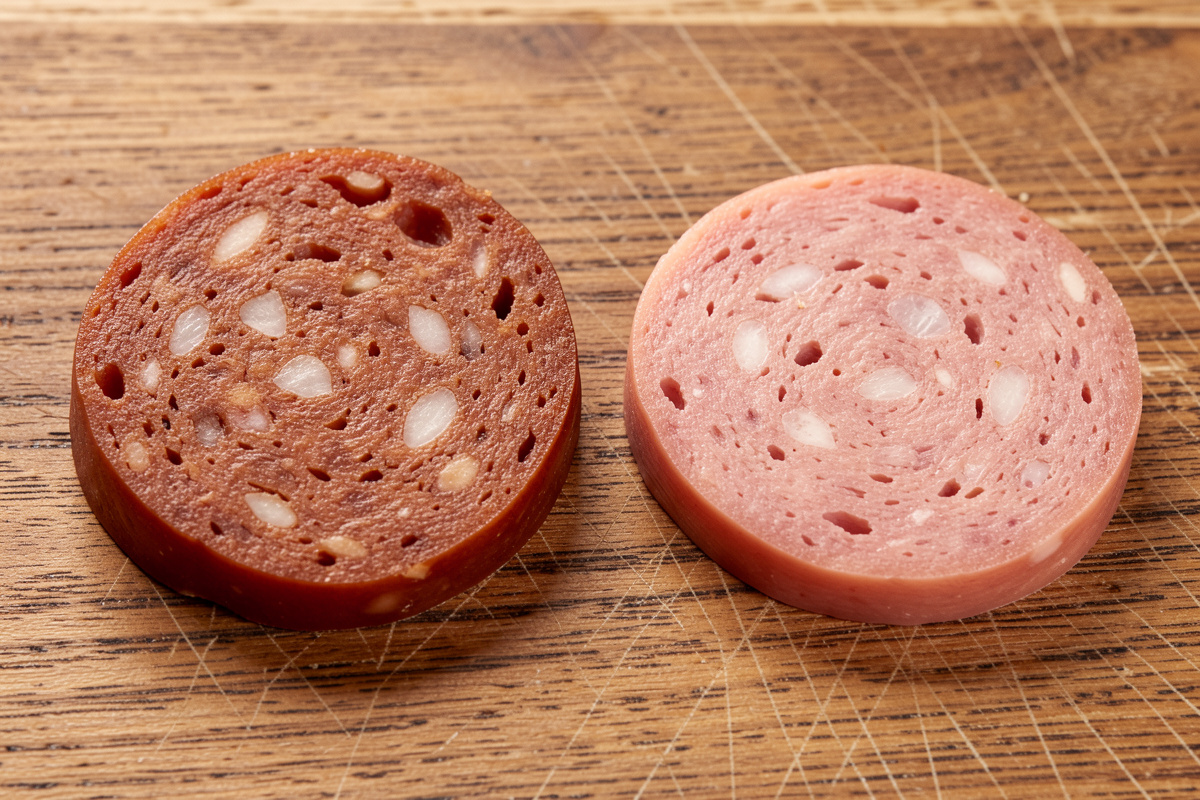
Before you change anything, work out whether your sausage is over-bound (rubbery) or under-bound (crumbly), because the fixes are opposites and applying the wrong one deepens the problem. A rubbery slice resists the tooth, springs back when you press it, and has a smooth, dense, almost homogeneous face; a crumbly slice falls apart, weeps moisture when cut, and shows distinct particles of meat and fat that never unified. One is too much bind, the other too little, and they share almost no fixes.
The press test is the fastest way to tell. Pinch a cold slice between thumb and finger: if it deforms and holds the dent, it’s tender and well-bound; if it springs back like an eraser, it’s over-bound (rubbery); if it crumbles or splits along grain lines, it’s under-bound. The same pinch test works on a frankfurter, a bologna slice, or a coarse fresh sausage — the texture scale is the same across the cooked-sausage family. Diagnose first, fix second, and you’ll stop reaching for the wrong lever.
The Top Causes of Rubbery Sausage — and the Fix for Each
Rubbery sausage traces to a small set of causes, and each has a distinct signature and a distinct cure. Here are the ones I see again and again, in rough order of how often they’re the culprit.
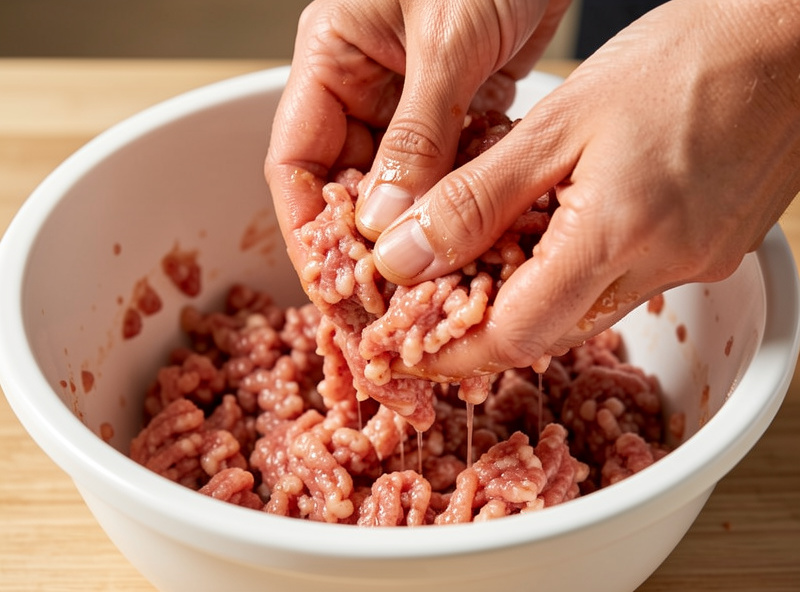
Over-mixing (the most common). Mixing past the point where the lean has gone glassy and sticky extracts more myosin than the sausage needs, building an over-tight gel. The signature is a smooth, dense, very uniform slice that reads more like a hot dog of pure protein than meat. The fix: stop mixing the moment the mass pulls together and turns glossy — for a coarse sausage, that’s a minute or two of kneading; for an emulsion, the instant the paste is smooth. The instinct to mix “a little more to be safe” is exactly the instinct that builds rubber.
Too much salt. Salt is the myosin-extraction tool, so more salt means more extraction means more bind means, past a threshold, rubber. Push above about 2.5% of meat weight and the sausage turns tough and reads as salty at the same time. The fix: hold salt at 1.8–2.2% for an emulsified sausage and 1.5–1.8% for a coarse fresh one, weighed on a gram scale. The recipes that say “two tablespoons of salt” without a weight are the recipes that produce rubbery results, because a tablespoon of kosher and a tablespoon of table salt are different masses.
Too much added water. In an emulsion, water is the second phase of the gel, and too much of it stretches the protein network into a sponge that snaps back — rubbery and prone to weeping. The signature is a cooked sausage that leaks moisture when sliced. The fix: cap ice water at about 20–25% of meat weight, weigh it, and resist the recipes that call for “a cup” unmeasured.
Cooking too fast and too hot. A sausage cooked hard — a fast boil, an over-hot poach, an aggressive grill — sets its proteins too tightly, the same way overcooking a steak makes it tough. The signature is a sausage that’s rubbery on the outside and still giving on the inside, or uniformly tight from edge to center. The fix: poach at 170–180 °F to a 155 °F internal, then ice-bath — the gentle cook and the shock both protect the texture, as the poaching guide covers in detail.
Over-grinding or re-grinding. Sending the meat through the grinder twice on the same plate, or grinding too fine for the style, shears the structure and over-extracts protein before you’ve even started mixing. The fix: grind once per plate, choose the plate for the style (coarse 6–8 mm for a brat, finer 3–4.5 mm for an emulsion), and never re-grind to “smooth it out.”
How Much Should I Mix Sausage, and When Do I Stop?
Mix only until the lean has gone glassy, sticky, and slightly lighter in color — the point where a handful of it pulls the whole mass together and leaves a sticky film on your palm. For a coarse fresh sausage that’s a minute or two of hand-mixing; for an emulsion it’s the moment the paste turns smooth and glossy in the cutter. Past that point, every additional turn of the bowl or pulse of the processor extracts more protein than you want, and the finished texture tightens accordingly.
The physical sign I trust is the climb: when the meat begins to climb the paddle or the blade instead of sliding off it, the primary bind is done. That’s the protein matrix forming, and it’s the same signal whether you’re making a coarse bratwurst or a fine bologna. The difference is only how far past that point you go — a coarse sausage stops right at the climb, an emulsion goes just far enough to smooth the paste and no further. When in doubt, under-mix; an under-mixed sausage is a little loose, and an over-mixed one is rubbery, and loose is the lesser failure.
Does Salt Make Sausage Rubbery?
Yes — past about 2.5% of meat weight, salt is a direct driver of rubbery texture, because it’s the compound that extracts the myosin that builds the gel. Below that line, salt is doing its necessary structural job; above it, you’ve over-built the gel and made the sausage taste aggressively salty into the bargain. The line is sharp enough that I treat salt weighing as the single most important precision step in sausage making — more important than the grind, more important than the seasoning blend — because it sits between a tender sausage and a rubber one.
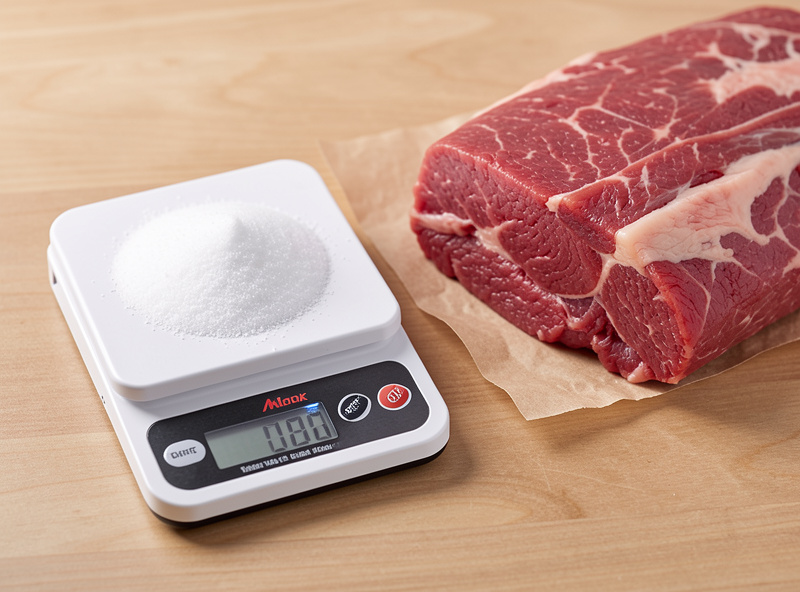
The reason volume measures betray you here is that salt density varies wildly by type. A tablespoon of fine table salt is roughly 18 g; a tablespoon of kosher salt can be anywhere from 8 to 14 g depending on the crystal. A recipe written for one salt, measured by another, can land anywhere from 1.5% to 3.5% salt by accident — and 3.5% is firmly in rubbery, over-salty territory. Weigh it: 18–20 g of salt per kilogram of meat for an emulsion, 15–18 g for a coarse sausage. The gram scale is the tool that makes salt reproducible, and it’s the same one that protects your Cure #1 rate from the same kind of accident.
Does Cooking Too Fast Cause a Rubbery Texture?
Yes — heat sets the protein gel, and setting it too fast or too far tightens it into rubber. A sausage poached at a rolling boil or grilled over too-high heat has its outer proteins seized before the center is done, and the result is a tight, tough casing of over-set protein around an undercooked or uneven core. The gentle cook — 170–180 °F water to a 155 °F internal, the target FSIS expects for a cooked, ready-to-eat sausage, then an ice bath — sets the gel slowly and evenly and stops it the instant it’s done, which is why a properly poached sausage is tender where a boiled one is bouncy.
The carryover cook is the hidden multiplier. A sausage pulled at 155 °F and left on the counter keeps cooking from its own residual heat, climbing another 5–10 °F, and each of those degrees tightens the gel further. The ice bath isn’t just a food-safety step — cooling fast through the danger zone — it’s a texture step, freezing the gel at the exact doneness you want. Skip it and the sausage you pulled tender finishes rubbery on the plate.
The Texture I’m Aiming For, and the Test I Use
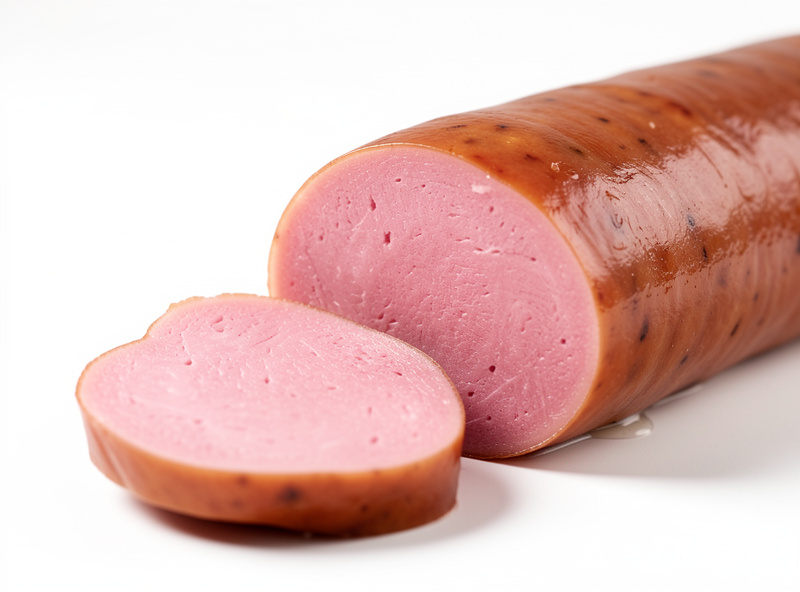
The target is a sausage that yields cleanly under the tooth, holds together without being dense, and shows a uniform but slightly open texture in cross-section — juicy, not bouncy, with the fat distributed as a fine matrix rather than pooling. The test I use is the cold slice press: cut a chilled slice a quarter-inch thick, press it between thumb and finger, and it should deform and hold a soft dent, not spring back. A frankfurter should snap in the casing and then give; a bologna slice should bend without cracking; a coarse bratwurst should be tender and juicy, not springy.
The batch that taught me this was an emulsified sausage I “improved” by mixing an extra three minutes for smoothness — it came out of the poach looking perfect and tasting like a pencil eraser. I’d over-extracted the myosin chasing a texture I already had, and no amount of fat or re-seasoning rescued it; the only fix was the next batch, mixed less. That’s the lesson across this whole page: rubbery sausage is the result of doing too much, and the cure is doing less — less mixing, less salt, less water, less heat. The recipe was never the problem; the hand on the mixer was.
What I’d do starting today, with a batch that’s come out rubbery: stop mixing earlier next time, weigh the salt to 1.8–2.2%, cap the water at 20–25%, grind once, and poach gently to 155 °F into an ice bath. Five changes, all in the direction of restraint, and the rubber goes out of the texture. The tools that make those changes reliable — a gram-accurate scale for the salt and water, and a fast probe for the cook — are the same two that fix most of what goes wrong in sausage making, because most of what goes wrong is a measurement that was guessed instead of taken.
As an Amazon Associate I earn from qualifying purchases.
Related Texture and Bind Guides
- Fixing a broken meat emulsion — the opposite failure: a bind that’s too loose and greasy rather than too tight.
- How to make hot dogs at home — the fine emulsion where over-mixing shows up first as rubber.
- Poaching temperature for cooked sausage — the gentle cook that stops heat from over-setting the gel.
- Do cooked sausages need Cure #1? — the same gram-scale discipline that protects your salt rate.
Why did my sausage come out rubbery?
It is over-bound: too much myosin was extracted, building a tight protein gel. The usual causes are mixing past the glassy-sticky stage, salt above about 2.5 percent, too much added water, or cooking too fast. Stop mixing earlier, weigh the salt, cap the water, and poach gently.
Does adding more fat fix rubbery sausage?
No. Rubbery sausage is over-bound, not under-fat; the fat is trapped inside an over-tight protein cage. Adding more fat gives you a rubbery sausage that is also greasy. Loosen the cage with less mixing, less salt, and less water instead of piling fat against a structure that will not release it.
How much salt is too much in sausage?
Above about 2.5 percent of meat weight, salt over-extracts myosin and makes the sausage rubbery and over-salty. Aim for 1.8 to 2.2 percent in an emulsified sausage and 1.5 to 1.8 percent in a coarse fresh one, weighed on a gram scale. Volume measures vary too much by salt type to be safe.
How do I know when to stop mixing sausage?
Stop the moment the lean turns glassy, sticky, and lighter in color and begins to climb the paddle or blade. That is the primary bind forming. A coarse sausage stops right there; an emulsion goes just far enough to smooth the paste. When in doubt, under-mix, because loose is a lesser failure than rubbery.
Can cooking too fast make sausage rubbery?
Yes. Heat sets the protein gel, and setting it too fast or too far tightens it. Poach at 170 to 180 Fahrenheit to a 155 Fahrenheit internal, then ice-bath to stop the carryover cook that would otherwise over-set the gel on the way to the plate.