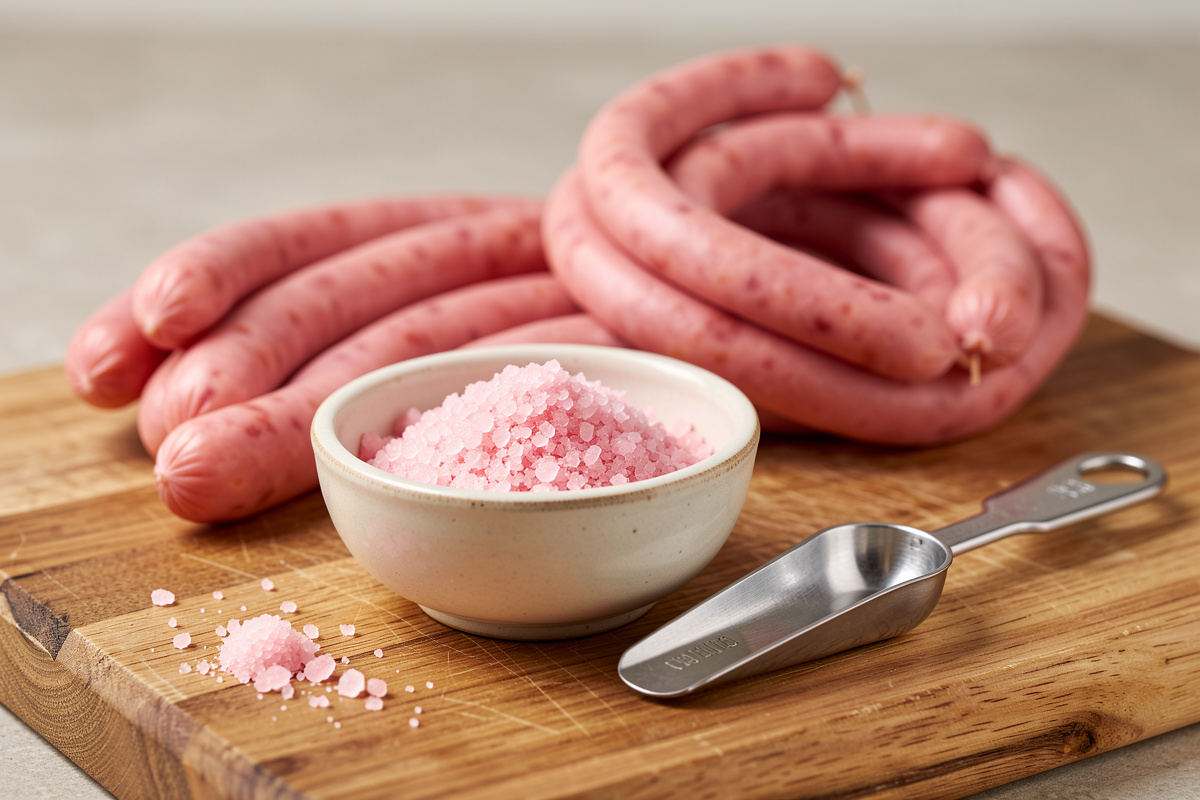
Do Cooked Sausages Need Cure #1? When Pink Salt Belongs in the Bind
July 18, 2026

A cooked sausage needs Cure #1 (6.25% sodium nitrite on a salt carrier) whenever it is smoked warm or otherwise held in the 40–140 °F (4.4–60 °C) danger zone before it’s cooked — because that’s the window in which Clostridium botulinum can produce toxin, and nitrite is the compound that prevents it. The home rate is one level teaspoon of Cure #1 per 5 lb of meat, which lands near the 156 ppm ingoing nitrite USDA allows in a ground or emulsified product. A frankfurter you poach and eat immediately has a softer case for it; a frankfurter you smoke-warm first does not.
This is the safety decision in the cooked-sausage family, and I treat it as the one place on this site where being confident-but-wrong does real harm. The good news is that the logic is clean and the rate is standard; the bad news is that the “natural, no-nitrate” marketing around it is misleading in a way that can get someone hurt. This page is the decision tree I run, built on the cooked sausage guide and the broader pink-salt explainer. It exists to answer one question — does this batch need cure, and if so how much — without romance or hedge where the science is settled.
The Short Answer: When Does a Cooked Sausage Need Cure #1?
If the sausage will be smoked warm, or held in the danger zone for more than a brief transit on its way to the cook, it needs Cure #1 at one level teaspoon per 5 lb of meat. If it goes straight from the fridge to a hot grill or a poaching pot and is eaten or chilled immediately, Cure #1 is optional — the danger-zone window that nitrite protects against simply doesn’t open. That single test — will it linger warm before cooking? — resolves almost every cooked-sausage cure question there is.
Concretely: a smoked frankfurter, a smoked bologna, a knackwurst, and any cold-smoked-then-cooked sausage all need Cure #1, because they spend hours between 40 and 140 °F. A fresh bratwurst grilled raw and an unsmoked, immediately-poached weisswurst do not, because they never linger there. The poach that finishes the sausage is itself the kill step; cure is the insurance that protects the sausage on the way to that kill step, not a substitute for it.
What Does Cure #1 Actually Do in a Sausage?
Cure #1 does three things, and only one of them is about safety. The safety job is botulinum control: sodium nitrite inhibits Clostridium botulinum growth and toxin production during the warm-smoke hold, which is exactly why a smoked sausage needs it. The other two jobs are quality — nitrite fixes the characteristic pink color (it reacts with myoglobin to form nitrosylmyoglobin, stable through cooking) and it contributes the cured-meat flavor that distinguishes a frankfurter from a plain ground-and-cooked sausage. People reach for cure for the color and taste, but the reason it exists is the safety.
The safety mechanism matters because it tells you the limits. Nitrite inhibits botulinum growth; it does not sterilise the meat, reverse spoilage, or rescue a batch that’s already been held warm too long. It buys time in the danger zone — it does not abolish the danger zone. That’s why I still poach to a verified internal, still ice-bath after, and still treat the smoke as a finish layered on an already-safe piece, exactly as FSIS expects for a cooked, ready-to-eat sausage. Cure is one layer of a multi-layer safety system, not a standalone.
The Decision Table
This is the table I keep by the chamber. Match the sausage to the row, read across, and the cure question is answered before you weigh anything.
| Sausage | Cure #1? | Why |
|---|---|---|
| Smoked frankfurter / hot dog | Yes | Smoked warm in the 120–140 °F danger zone; nitrite prevents botulinum toxin |
| Smoked bologna (ring or chub) | Yes | Same — long warm smoke before the cook |
| Knockwurst / knackwurst | Yes | Smoked then poached; danger-zone hold during smoke |
| Cold-smoked, then cooked | Yes (cure before smoke) | Smoke is applied in the danger zone; cure first, always |
| Fresh bratwurst (grilled raw) | No | Fridge to grill; never lingers warm |
| Weisswurst (poached, unsmoked) | Optional | Poached immediately, no warm-smoke hold |
| Dry-cured salami | Cure #2 (not #1) | Long ferment and dry; nitrate converts to nitrite over weeks |
Two things to notice. First, the smoked-cooked sausages all say yes and the fresh-immediate ones all say no — the deciding variable is the danger-zone hold, not the sausage’s name. Second, dry-cured salami is the one row that wants Cure #2, not #1, because its safety model is weeks-long drying and fermentation, not a single hot cook. The Cure #1-versus-#2 mixup guide covers that distinction in depth; for a cooked sausage the answer is always #1.
How Much Cure #1 Do I Use, and How Do I Measure It?
The rate I use and trust: one level teaspoon of Cure #1 per 5 lb (2.27 kg) of meat and fat, which works out to roughly 4 oz per 100 lb, or about 0.25% of meat weight, delivering close to the 156 ppm ingoing nitrite that USDA permits in a comminuted meat product. Weigh it on a gram-accurate scale whenever you can — a level teaspoon is a fine home approximation, but a heaping one drifts high, and with nitrite, high is not better. Never exceed the rate; more cure does not mean safer, and nitrite is toxic in overdose, which is exactly why curing salt is dyed pink so no one confuses it with table salt.
As an Amazon Associate I earn from qualifying purchases.
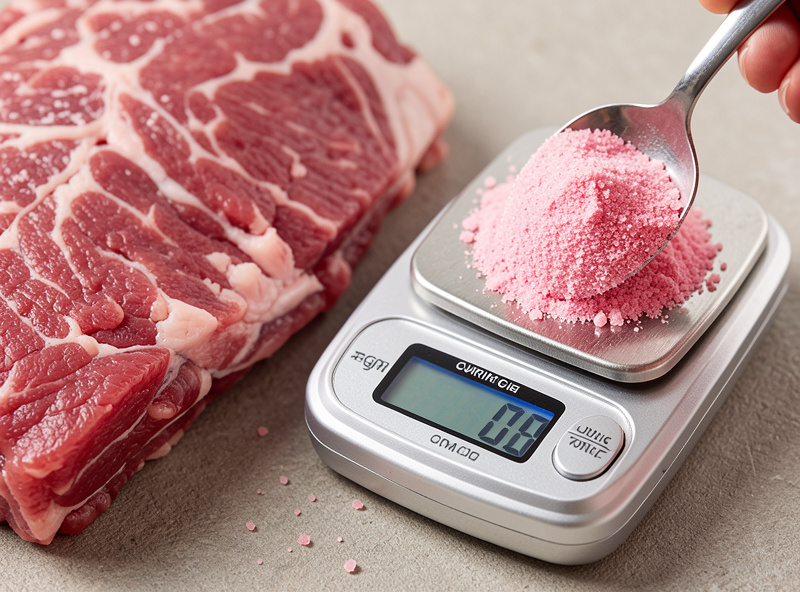
Dissolve the weighed Cure #1 into the ice water you’ll use for the emulsion, or distribute it through the salt that goes onto the lean at the start of the bind, so it disperses evenly through the meat rather than landing in a pocket. Uneven cure distribution gives you a sausage that’s undercured in places — grey, unprotected — and overcured in others, which is both a color problem and, in the undercured spots, a safety gap. The reason I dissolve rather than sprinkle is a batch I got wrong early on: I dusted the cure straight onto the lean, and even after a long mix the finished frank carried a pale grey streak where the nitrite never reached — undercured and unprotected in that one band. It was safe enough because the smoke hold was short, but it looked wrong, and it’s why the weighed cure now goes into the ice water so it travels everywhere the meat does.
A practical note on handling: treat Cure #1 as a chemical, because it is one. Keep it labeled and away from anything edible that isn’t a cure; the pink dye is the safeguard that stops a careless pinch from being added to a soup. I store mine in a labeled jar separate from the kitchen salt, and I measure it over a sheet of paper I can funnel back, not over the meat, so a spill is visible and recoverable. The same care applies to every food-safety decision in charcuterie — competence is the shield, and nitrite is where that competence has to be exact.
Can I Use “Natural, No-Nitrate” Celery Cure Instead?
You can, but it is not a free pass, and it is not chemically different in the finished sausage. “Natural” or “no-nitrate” cures use celery juice or celery powder, which is high in naturally occurring nitrate; a starter culture converts that nitrate to nitrite during the process, and the nitrite ends up in the meat doing exactly what added Cure #1 would do. The result is that a “no-nitrate-added” sausage often contains comparable nitrite to a conventionally cured one — the nitrite just arrived by a different route. The research on this is fairly clear, and the marketing is fuzzier than the chemistry.
The honest position: if you object to adding purified sodium nitrite on principle, a celery-based cure will cure the sausage and protect against botulism, and it’s a defensible choice. What it is not is a way to skip curing while claiming safety — an uncured warm-smoked sausage is an uncured warm-smoked sausage regardless of the label, and the botulism risk is identical. My own choice is to use Cure #1 directly, weighed by gram, because I’d rather know the exact ingoing nitrite than trust a celery powder’s variable nitrate content. If you go the celery route, follow the manufacturer’s rate and don’t freeload on the dose.
Cure #1 vs Cure #2: Why a Cooked Sausage Wants #1
Cure #1 is sodium nitrite on salt (6.25% nitrite); Cure #2 adds sodium nitrate, which is a slow-release reservoir that bacteria convert to nitrite over the weeks of a long dry-cure. A cooked sausage wants #1, full stop, because there is no long drying phase for the nitrate in #2 to convert — the nitrate would sit in the meat unconverted, which is not what you want in a product cooked and eaten within days. Using #2 in a cooked sausage is a misunderstanding of what each cure is for, and it’s a common enough error that I’d flag it before you reach for the jar.
The rule of thumb: short cures and anything cooked or hot-smoked take #1; long dry-cures and fermented sausages take #2. A frankfurter, a bologna, a knackwurst — all #1. A salami, a coppa, a bologna’s distant dry-cured cousins — #2. If you ever doubt which jar you’re holding, the mixup guide walks through how to tell them apart before you add anything to the meat. Getting this wrong is the one cure mistake that’s both easy to make and genuinely consequential.
Does Cure Make a Cold-Smoked Sausage Safe?
No — cure is necessary for a cold-smoked sausage, but it does not by itself make the sausage safe. Cold smoke is applied in the danger zone, so the meat must already be cured (with #1, or #2 for a long dry-cure) before smoke touches it, and cold smoke is a flavor and color step layered onto a piece that’s already been brought to a safe water-activity or a safe cook — never the preservation step itself. I treat smoke the way I treat cure: as one layer in a multi-layer safety system. The danger zone doesn’t move because you’re smoking instead of resting, and I track my chamber temperature on a SensorPush HT.W to be certain a cold smoke stays cold.
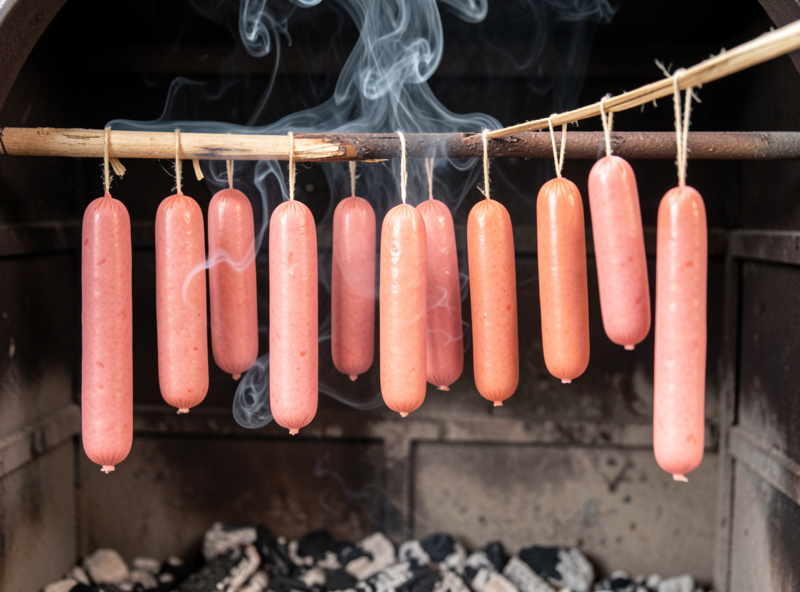
The reason this matters for cooked sausage specifically is that a frankfurter or bologna is technically warm-smoked, not cold-smoked — but the principle holds. You cure first, smoke second, and cook third; you never rely on smoke to do the work of cure or heat. The color you watch develop during the smoke — the grey-pink paste deepening to the familiar frankfurter rose as the nitrite sets in the presence of heat and smoke — is the visible signature that the cure is doing its job. It’s the one part of nitrite chemistry you can see with your eyes.
What I’d tell someone weighing their first cure: if the sausage smokes, cure it at one level teaspoon per 5 lb, weigh it on a gram scale, use #1 not #2, and don’t let any “natural” label talk you out of protecting a warm-smoked batch. The cure is the cheapest, smallest, most consequential ingredient in the whole cooked-sausage process — a quarter-teaspoon of pink salt is the difference between a smoked frank that’s safe to hang in the danger zone for three hours and one that isn’t. Treat it with the seriousness it earns, and the rest of the technique gets a lot more forgiving.
Related Cure and Cooked-Sausage Guides
- How to make hot dogs at home — the smoked frankfurter that puts this cure decision into practice.
- How to make bologna at home — a long warm-smoked chub, where Cure #1 is non-negotiable.
- Poaching temperature for cooked sausage — the kill step that cure protects the sausage on the way to.
- Why are my sausages rubbery? — the texture failure that sits next to the cure question in the bind.
Do all cooked sausages need Cure #1?
No. A cooked sausage needs Cure #1 only if it is smoked warm or held in the 40 to 140 Fahrenheit danger zone before cooking. A fresh bratwurst grilled raw or an unsmoked weisswurst poached immediately does not need it. Smoked franks, bologna, and knackwurst do.
How much Cure #1 do I use per pound of sausage?
One level teaspoon of Cure #1 per 5 pounds of meat, about 4 ounces per 100 pounds, or roughly 0.25 percent of meat weight. That delivers close to the 156 ppm ingoing nitrite USDA allows in a comminuted product. Never exceed the rate; more is not safer, and nitrite is toxic in overdose.
What happens if I use too much Cure #1?
Nitrite is toxic at high doses, which is why curing salt is dyed pink so it is not confused with table salt. Overdosing does not make the sausage safer and creates a real safety risk. Weigh Cure #1 on a gram scale, never heap the measure, and store it labeled and separate from kitchen salt.
Is celery powder cure a safe substitute for Cure #1?
Celery-based cure works because bacteria convert its natural nitrate to nitrite, so the nitrite ends up in the meat doing the same job. It is a defensible choice but not a way to skip curing; an uncured warm-smoked sausage carries the same botulism risk regardless of the label. Use the manufacturer rate and do not skimp.
Should I use Cure #1 or Cure #2 in a cooked sausage?
Use Cure #1. Cure #2 contains sodium nitrate meant for long dry-cured and fermented sausages, where bacteria convert the nitrate to nitrite over weeks. A cooked sausage has no long drying phase, so the nitrate in Cure #2 would sit unconverted. Cooked and hot-smoked sausages always take Cure #1.