Poaching Temperature for Cooked Sausage: Hitting the Internal Without Splitting
July 15, 2026

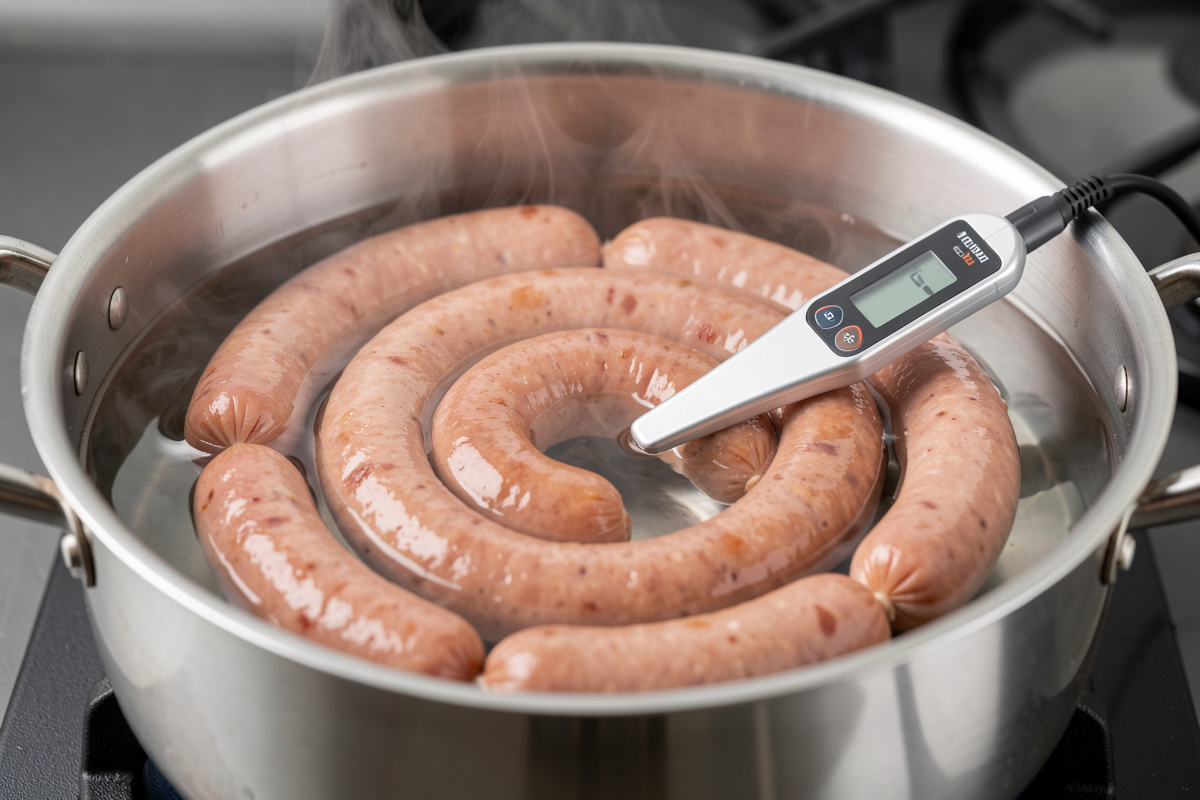
Poach cooked sausage in water held at 170–180 °F (77–82 °C) — never a rolling boil — until the thickest link reaches an internal of 152 °F (66.7 °C) minimum, or 155 °F (68 °C) for a comfortable margin, then shock it cold in an ice bath. Those three numbers — the water, the internal, and the shock — are the entire craft of poaching, and getting the water right is what stops casings from splitting while the sausage still cooks through to safe.
Poaching is the step where a cooked sausage is made safe and where its texture is decided, and it’s the step home cooks most often get wrong by reaching for a boil. A boiling pot is the enemy of a good frank — it jostles the links, ruptures casings from steam pressure, and drives the internal so fast the outside overcooks before the center is done. This page is the poach method I run across franks, bologna, and weisswurst; it sits inside the cooked sausage guide and pulls on the specific cook details each of those frank, bologna, and weisswurst pages references but doesn’t dwell on.
What Temperature Should I Poach Cooked Sausage At?
Hold the poaching water at 170–180 °F (77–82 °C). That range is hot enough to cook a sausage through in a reasonable time but calm enough that the casing survives and the fat stays inside the emulsion. Below about 165 °F the cook crawls and the sausage lingers in the danger zone too long; above about 185 °F the water jostles, steam pockets form under the casing, and the casing ruptures along its weakest seam. The sweet spot — calm, steaming faintly, with only the occasional slow bubble clinging to the pot wall — reads as “hot but not boiling” on the eye.
The reason a boil is destructive is half mechanical, half thermal. Mechanically, rolling water throws the links against each other and against the pot, stressing the casing; thermally, water at 212 °F drives the surface of the sausage to temperature far faster than the center, so the outer emulsion over-sets and goes mealy while you’re still waiting for the middle to be safe. A 175 °F poach cooks the sausage more evenly — surface and center rise together — which is exactly why the finished texture is tender rather than tough. I treat a faint wisp of steam and the absence of bubbles as my visual target, then confirm with a probe in the water.
Use enough water to fully submerge the batch by an inch or two, in the widest pot you have, so the links lie flat and the temperature doesn’t crash when you add them. Cold links dropped into hot water pull the temperature down sharply — a full string of fridge-cold franks can drop a small pot by 20–30 °F — so heat a little above target, add the sausage, let it recover, and then modulate. The food-safety guide covers the danger-zone transit; for poaching the rule is to get the water back above 165 °F promptly so the cook doesn’t stall in the zone where bacteria multiply.
What Internal Temperature Is a Cooked Sausage Done?
A cooked sausage is done at a 152 °F (66.7 °C) internal minimum, held briefly, which is the FSIS lethality standard for cooked, ready-to-eat sausage; the USDA consumer guidance is 160 °F (71 °C) for zero ambiguity. I poach franks and weisswurst to 155 °F and bologna to 155–158 °F, because the extra degrees are cheap insurance against a slow probe or a cold spot, and the texture stays tender through that range. FSIS treats these as cooked sausages under its lethality performance standard, and a 152–155 °F poach held for even a minute satisfies it.
The number is a floor, not a target to overshoot. Every degree past about 158 °F costs texture — the emulsion tightens, moisture is driven out, and the slice goes from tender to mealy. This is the central tension of poaching: cook hot enough and long enough to be safe, but pull the instant you are, because the sausage keeps cooking from its own residual heat after it leaves the water. That carryover is why the ice bath matters as much as the poach.
Why Do Sausage Casings Split When I Poach Them?
Casings split for three reasons: the water was too hot (above ~185 °F), the casing was over-stuffed, or there’s an air pocket trapped inside that expands into steam and blows the seam. The fix is to hold the water at 175 °F, stuff with a little give left in the casing, and prick any visible air bubbles with a sterile needle before the links go into the water. A rolling boil will split almost every link in the pot; a calm 175 °F poach will split almost none.
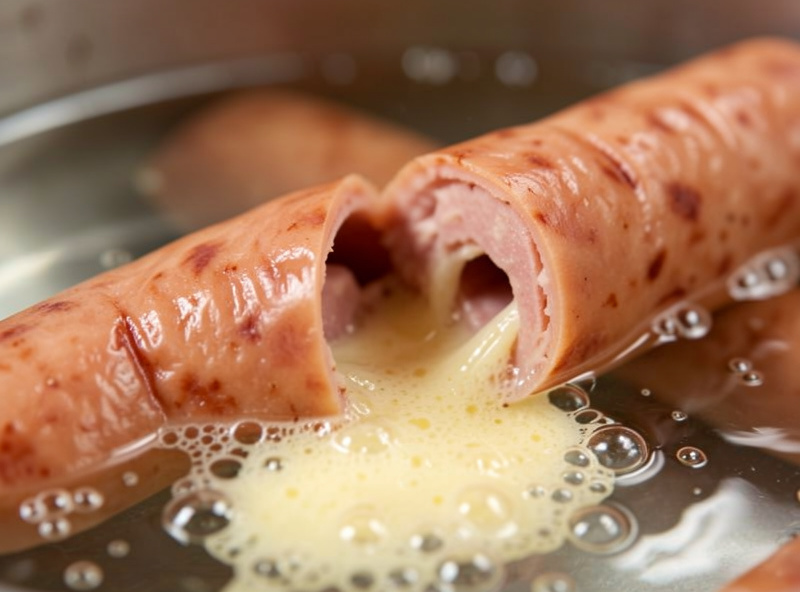
The mechanism is steam pressure. A casing is a semi-permeable membrane; liquid water passes through it slowly, but steam expands fast and vents slowly, so when the water inside the link boils (or when trapped air expands past the casing’s tolerance), the pressure finds the weakest point and blows it open. Over-stuffing makes every point a weak point; air pockets give the steam a place to gather. Natural casings split along the grain; collagen casings tend to tear at the seam. None of it is dangerous to eat — the emulsion is mostly set by the time a split happens — but it ruins the shape and costs you paste into the water.
If you’re splitting casings regularly and the water is right, the culprit is almost always the stuff. I stuff to about 90% of bursting and then let the casing relax a minute before linking, which gives the meat room to expand as it heats. For large bologna chubs I stuff even gentler, because a 60 mm casing under pressure is a much bigger bang than a 22 mm frank.
How Long Does It Take to Poach Different Sausage Sizes?
Poaching time scales with diameter, not weight, because heat has to conduct from the surface to the center and conduction time grows with the square of the radius. A 22 mm sheep-casing frank reaches 155 °F internal in about 20–30 minutes; a 32 mm hog-casing sausage takes 30–40 minutes; a 60 mm bologna chub takes 60–90 minutes; a 90 mm bung can take two hours. Cook by internal probe, never by the clock — the clock is a rough guide, the probe is the verdict.
The practical consequence is that you cannot poach a mixed batch to a single time. If you hang franks and a bologna chub in the same pot, the franks will be vastly overcooked by the time the bologna’s center is safe. Either poach like with like, or pull the small links as they come up to temp and leave the large ones in. I start the probe in the thickest piece and pull individual links as they each hit 155 °F, dropping them straight into the ice bath. The emulsion that survived the grind shouldn’t die in the poach from inattention.
Should I Shock the Sausage in an Ice Bath After Poaching?
Yes — always. The instant a link hits its target internal, lift it out and plunge it into a bowl of ice water to stop the cook. A poached sausage carries enough residual heat to climb another 5–10 °F after it leaves the water — more for a thick chub, less for a thin frank — and that carryover is what turns a tender sausage mealy. The ice bath freezes the structure where you want it: plump, smooth, and set.
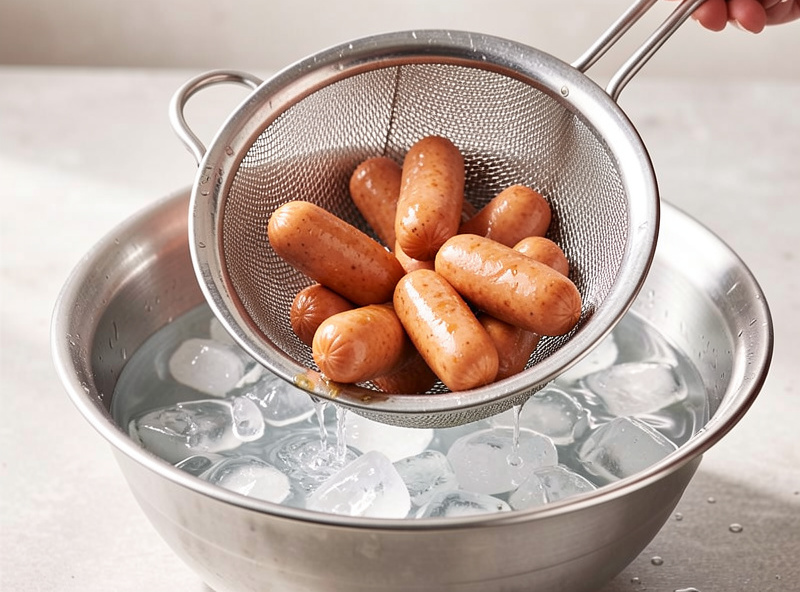
The ice bath also does food-safety work, not just texture work. Cooling a cooked sausage rapidly from its cook temperature down through the 40–140 °F danger zone minimises the window in which any surviving bacteria could regrow, which is why FSIS emphasises rapid cooling of cooked meats. Give the sausage a full 10–15 minutes in the ice water — long enough that the center has dropped well below 100 °F — then drain, pat dry, and refrigerate. Letting it rest cold overnight before slicing lets the gel fully set and improves the snap.
Can I Use a Sous-Vide or Slow Cooker to Poach Sausage?
Yes, and a sous-vide circulator is genuinely the best home tool for holding a precise poach, because it eliminates the temperature swings that cause splits. Set the bath to 170–175 °F, drop the sealed or loose links in, and cook to internal — the water can’t overshoot to a boil, so the casing is safe and the cook is even. I don’t bag the sausages for a true poach (I want water contact for the traditional texture), but I do use the circulator to hold the pot’s temperature rock-steady. A slow cooker works in principle but cycles too widely on most models — the low setting often sits below a safe cook temperature and the high setting overshoots — so I’d verify with a probe before trusting one.
The honest trade-off of a precise sous-vide poach is that it’s slower than a 180 °F pot poach, because a smaller temperature difference between water and target means slower heat transfer. For a thin frank that’s a few extra minutes; for a thick bologna it can add half an hour. I use the circulator for delicate work like weisswurst, where the gentlest possible cook protects a fragile emulsion, and a plain pot on the stove for workhorse franks where speed matters more than finesse.
The Probe Versus the Clock: Why I Never Trust Time
The batch that taught me to distrust the clock was a string of franks I pulled at “thirty minutes, like the recipe said.” The recipe’s author had poached in a different pot, at a different volume, from a different fridge temperature, and the franks I trusted to be done were at 144 °F internal — undercooked and unsafe, though they looked identical to a finished link on the outside. Every variable that isn’t the internal temperature — pot size, water volume, starting temperature, link caliber, how many links are in the bath — shifts the time, and none of them shifts it predictably enough to cook by minutes.
The probe settles it. I keep a fast instant-read thermometer next to the pot and probe the thickest link every few minutes once I’m in the expected window; the instant it reads 155 °F, the whole batch comes out to the ice bath. The smell tells me when to start probing — a clean, warm-meat aroma with a thread of smoke means the cook is progressing well; a flat, fatty, boiled-out smell means a casing has split or the emulsion is weeping, and I go looking for the problem link. If you buy one thing for poaching, buy the probe: a fast instant-read thermometer is the single tool that turns poaching from a guess into a measurement, and it’s the same probe that confirms every other temperature on this site.
As an Amazon Associate I earn from qualifying purchases.
What I’d tell someone poaching their first batch: fill a wide pot, heat to 175 °F and confirm with the probe, drop the links in, let the water recover, and probe the thickest piece toward the expected time — then pull the instant it reads 155 °F and straight into ice water. Three numbers, one probe, and the casings will hold and the sausage will be safe and tender every time. The poach is the simplest step in cooked sausage making to get right, and the easiest to get wrong by turning up the heat.
Related Guides for Cooking Cooked Sausage
- How to make hot dogs at home — the frankfurter poach this method was written around.
- How to make bologna at home — the long, gentle poach a thick chub demands.
- Do cooked sausages need Cure #1? — the cure decision that runs before the smoke and the poach.
- Why are my sausages rubbery? — when the texture problem is the bind, not the poach.
What temperature should the poaching water be for cooked sausage?
Hold the poaching water at 170 to 180 Fahrenheit (77 to 82 Celsius). That range is hot enough to cook the sausage through but calm enough that the casing survives and the fat stays inside the emulsion. Above 185 Fahrenheit the water jostles and steam pockets split the casing; never use a rolling boil.
What internal temperature is cooked sausage fully done?
Cooked sausage is done at a 152 Fahrenheit (66.7 Celsius) internal minimum, the FSIS lethality standard, or 155 Fahrenheit for a comfortable margin. The USDA consumer guidance is 160 Fahrenheit for zero ambiguity. Pull the instant the thickest link hits target and shock it in an ice bath.
Why do my sausage casings split when poaching?
The water was above about 185 Fahrenheit, the casings were over-stuffed, or an air pocket expanded into steam. Hold the water at 175 Fahrenheit, stuff with a little give left in the casing, and prick visible air bubbles with a sterile needle before poaching. A rolling boil will split almost every link.
How long do I poach sausages?
Time scales with diameter: a 22 millimeter frank takes 20 to 30 minutes, a 32 millimeter hog-casing sausage 30 to 40 minutes, and a 60 millimeter bologna chub 60 to 90 minutes. Always confirm with an instant-read probe in the center, never by the clock, since pot size and starting temperature shift the time.
Do I need to ice-bath sausages after poaching?
Yes. A poached sausage carries enough residual heat to climb another 5 to 10 Fahrenheit after it leaves the water, which turns a tender texture mealy, and rapid cooling through the danger zone is a food-safety requirement. Plunge the links into ice water for 10 to 15 minutes as soon as they hit target internal.